




Understanding neurogenic claudication
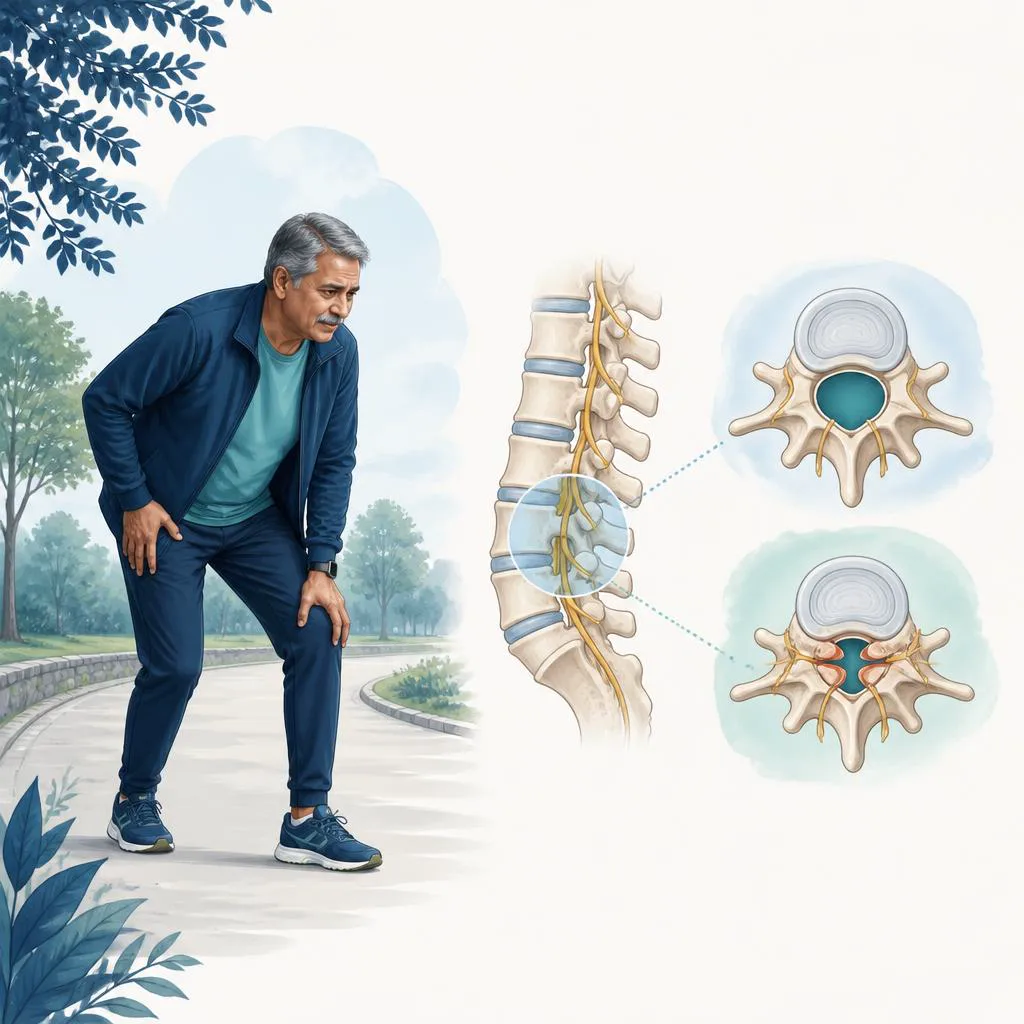
Lumbar spinal stenosis can narrow the space around nerves. Some people develop leg or buttock discomfort, numbness or weakness when standing or walking and feel better when sitting or leaning forward. This is called neurogenic claudication. It is a pattern to discuss with a clinician, not a diagnosis to make from a walking-distance test at home.
Other conditions can limit walking too
Poor circulation, hip disease and other problems can cause similar limitations. A clinician asks whether posture changes symptoms, how far you can walk and what happens with rest. They examine relevant neurological and circulation findings. More than one problem can coexist, so a spinal scan alone may not explain everything.
What MRI and X-rays show
MRI can assess nerve spaces and surrounding tissues. X-rays may help evaluate alignment or a vertebral slip. The severity of a scan finding must be interpreted alongside symptoms and function. Some people with narrowing have few symptoms, while others have meaningful limitations. The treatment decision should reflect the whole assessment.
Options before and including surgery
A clinician may recommend supervised rehabilitation, activity changes or medicines when appropriate. Persistent limitation or progressive deficits can prompt a decompression discussion. Fusion is not automatically needed with every decompression; instability is one factor. Ask what the proposed treatment aims to improve and how walking and daily function will be reassessed.
When a walking problem needs urgent help
Rapidly worsening weakness, new bladder or bowel difficulties or saddle-area numbness needs emergency assessment. Do not assume these are routine ageing or ordinary stenosis. Bring records and medication details to a planned visit, but do not let paperwork delay urgent care. The appropriate pathway depends on the change in function and associated symptoms.
Further information and next steps in Sangli
For related evaluation and treatment information, read our [spinal stenosis treatment](/departments/neurosurgery/spinal-stenosis-treatment) guide. You can also meet [Dr. Rohan Patil](/doctors/dr-rohan-patil), explore the [brain and spine information hub](/brain-spine-centre-sangli), or [contact the hospital](/contact). An online appointment is not an emergency pathway.
References and editorial review
Educational information does not replace an examination. Review is due annually and earlier if evidence or clinical scope changes. Reviewer credits appear only after an actual review of this version.